
Privacy duties
Client Consent for AI Meeting Recording in Canada: A Three-Layer Guide for Advisors
Recording a client meeting with an AI note-taker triggers three Canadian consent and recordkeeping rules. The Criminal Code, PIPEDA, and CIRO each ask a separate question. Practical scripts and a CRM audit trail for advisors.

“One consent doesn't cover three obligations.”
TL;DR
Do I need client consent to record a meeting with AI in Canada?
Recording a client meeting with an AI note-taker raises two Canadian consent obligations. Criminal Code section 184 makes the recording lawful when one party consents. PIPEDA requires the client's meaningful consent to the collection, use, and AI processing of the personal information in the recording. Both apply on every recorded meeting, and CIRO's recordkeeping rules apply to the resulting records.
Canadian advisors often hear their country described as a "one-party consent" jurisdiction, meaning one participant in a conversation can lawfully record it without telling the other. That framing is accurate for the Criminal Code. It covers one layer of the stack. The Criminal Code addresses whether the recording itself is lawful. PIPEDA governs what the advisor can then do with the personal information the recording contains. CIRO's books-and-records rules apply once that information becomes a firm record. Each layer has its own statute and its own duties. Consent to record, under the Criminal Code, covers only that layer.
The three-layer consent stack every Canadian advisor needs to know
Three separate layers of Canadian law apply to a recorded AI-assisted client meeting. I'm calling it the three-layer consent stack. This is a synthesis of the underlying law, rather than an official CIRO framework. Each layer has its own question, its own statute, and its own duty on the advisor.
- Layer 1: The act of recording. The Criminal Code governs whether the recording itself is lawful. Section 184(1) prohibits the interception of private communication; section 184(2)(a) creates a one-party consent exception when a participant in the communication agrees.
- Layer 2: The handling of personal information. PIPEDA governs what can be collected, used, disclosed, and processed, including by an AI tool. The client's consent must be meaningful under the OPC's 2018 Guidelines, which set out elements the advisor should name up front.
- Layer 3: What the recording becomes once it enters the firm. CIRO's IDPC rules govern books-and-records, supervision, retention, and outsourcing obligations once the recording or the AI-generated summary becomes a firm record.
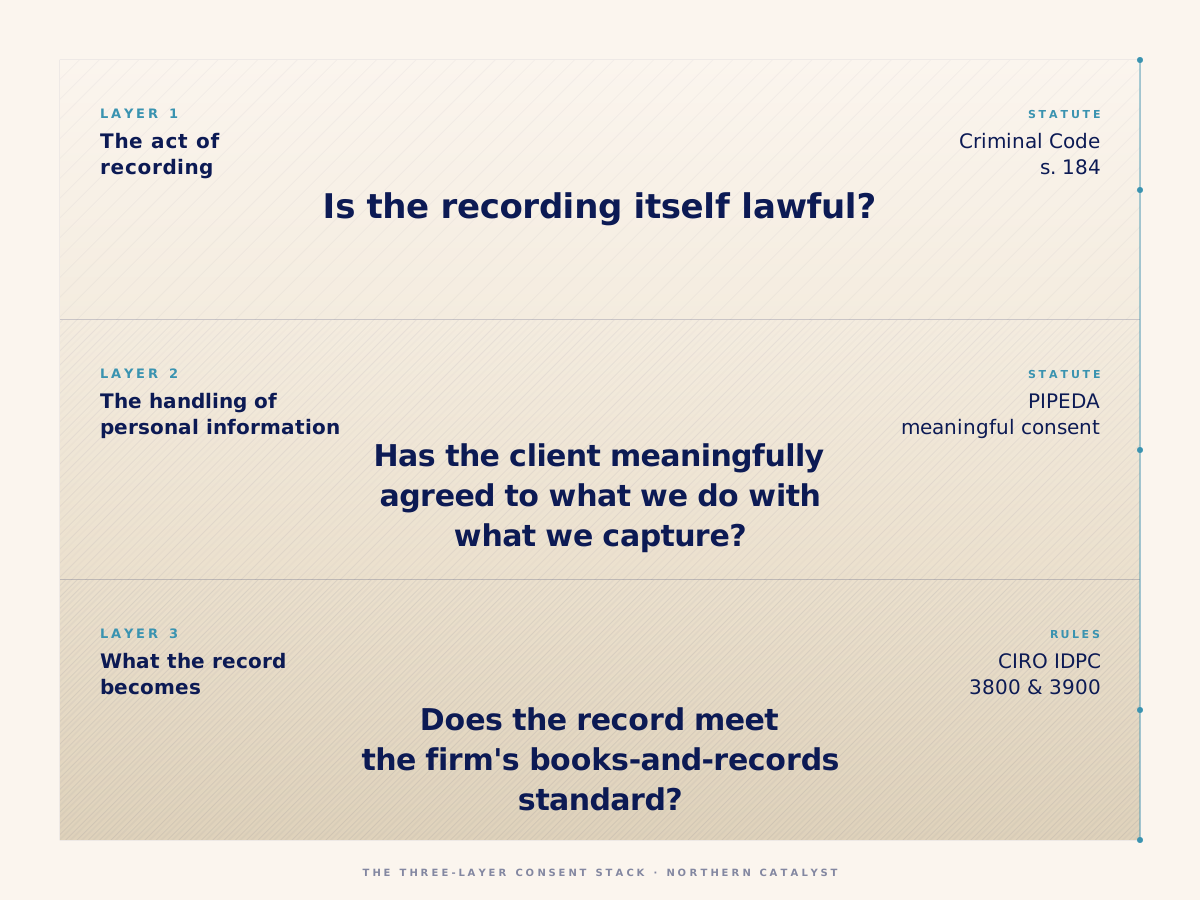
One consent doesn't cover three obligations.
Criminal Code section 184 and one-party consent
One-party consent in Canada means that one participant in a private communication can lawfully record it even where the other party has not been told. Criminal Code section 184(2)(a) creates this exception to the general rule in section 184(1). A CIRO-registered advisor who takes part in a client meeting is a participant for this purpose.
The Supreme Court confirmed the one-party rule in Goldman v. The Queen in 1979. The majority held that consent by one party, whether originator or intended recipient, makes the recording lawful under what is now section 184(2)(a). The consent must exist at the moment of recording.
For firm counsel
One open question the Supreme Court has not resolved is how the rule operates when the consenting party is acting as agent for a corporate principal. This matters for advisors because the firm is a practical second party to every meeting recorded on firm tools. Firm counsel is the right place to look for the specific answer.
Turning on an AI note-taker on your own device during a client Zoom call satisfies section 184. You are a participant, and your own consent covers the interception. Every other consent question is still open. If your assistant starts the recorder before you join the call, the assistant is outside the call. With that in mind, the recording is an unlawful interception.
A note on Duarte
Advisors who have heard of Canadian recording case law have usually heard of R. v. Duarte (1990). The case is often paraphrased as the Supreme Court saying judicial authorization is needed to record a private conversation. Duarte involved an undercover police officer; the Supreme Court held that state-actor recording engages section 8 of the Charter and requires prior judicial authorization. A financial advisor recording a client meeting is a private party. The Charter analysis in Duarte applies only to state actors.
Why notes still work
In R. v. Fliss (2002), the Supreme Court excluded a covert police recording under section 24(2) of the Charter but held that the officer's independent oral testimony about the same conversation was admissible even without the tape. Memory sits outside the statutory definition of intercepted communication. An advisor's careful contemporaneous notes carry the same independent evidential weight.
PIPEDA meaningful consent for AI processing
PIPEDA requires meaningful consent before client personal information is collected, used, or disclosed, including when an AI tool processes it. The OPC's 2018 Meaningful Consent Guidelines name four key elements the advisor must cover up front: what information is collected, with whom it will be shared, the purposes, and the risks of harm.
The Criminal Code addresses whether the recording is lawful. PIPEDA governs what happens to the personal information inside the recording. These are separate consent questions, with separate standards.
The trigger stack
PIPEDA Principle 4.3.4 allows consent to be implied or express depending on the circumstances. The OPC's Meaningful Consent Guidelines name three triggers that generally require express consent: sensitive information, collection or use outside reasonable expectations, or meaningful residual risk of significant harm. All three fire for advisor AI meeting recording.
Voice is biometric.
The OPC's Interpretation Bulletin on Sensitive Information treats biometric information that can uniquely identify an individual as sensitive regardless of context. Voice meets that definition. In Quebec, Law 25 imposes a statutory express-consent requirement for biometric data.
What clients must actually be told
Meaningful consent under Principle 4.3.2 requires the client to receive the information in a form they can reasonably understand. The Guidelines name four elements the advisor must cover up front:
- What is collected. Audio of the meeting, a transcription, and any data derived from them.
- With whom it will be shared. The vendor, any sub-processors, and the geographic location of processing.
- Purposes. Summarization, CRM record creation, compliance documentation, and whether data trains the vendor's models.
- Risks. Inaccurate summaries in regulatory documentation, vendor retention, cross-border transmission, and residual harm from vendor breach.
Withdrawal, and the honest tension with CIRO retention
Principle 4.3.8 gives clients the right to withdraw consent at any time, subject to legal or contractual restrictions. PIPEDA Case Summary #2003-249 held that informing a customer of the right is insufficient when the operational mechanism does not work. For AI recording, the operational obligation requires the advisor to stop mid-meeting on request, delete the audio, transcript, embeddings, and vendor-side derived data, and confirm deletion back to the client.
A genuine tension sits between Principle 4.3.8 and CIRO recordkeeping. A client may withdraw consent after the meeting summary has become firm books-and-records material. The resolution is asymmetric: the regulated summary stays; the supporting AI artifacts come out. Firm counsel is the right place to confirm which records belong in which bucket.
CIRO supervision once the recording becomes a record
CIRO has not published a rule that prescribes a particular form of client consent for meeting recordings. Once the recording or an AI-generated summary enters the firm's books and records, CIRO recordkeeping, supervision, and retention rules apply. The consent itself sits under PIPEDA and, where applicable, Quebec Law 25, BC PIPA, or Alberta PIPA.
The four buckets
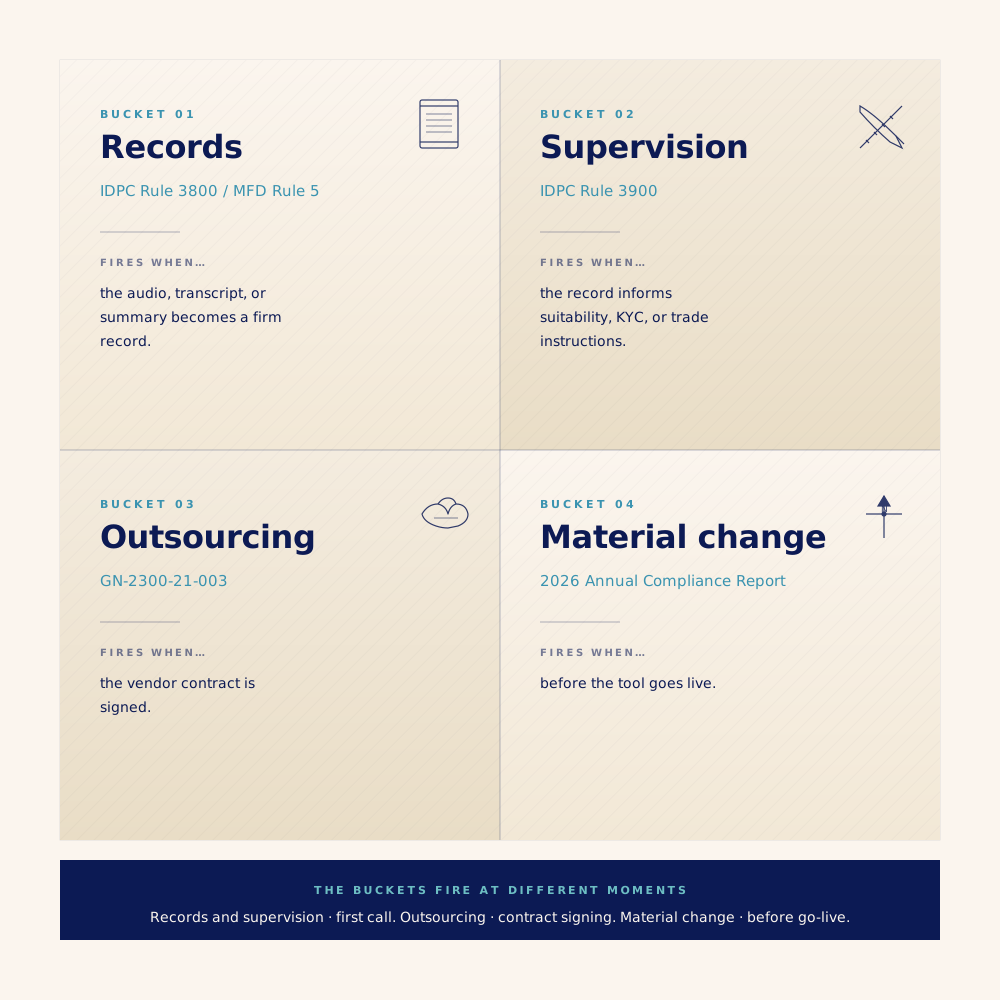
Records. An audio recording, a transcript, or an AI-generated summary becomes a firm record when its content relates to the firm's business or a client transaction. IDPC Rule 3800 applies medium-neutrally; MFD Rule 5 applies in parallel for mutual fund dealers. Seven-year retention runs from creation.
Supervision. Where a recording or summary informs a suitability decision, KYC update, or trade instruction, it joins the supervisory file under IDPC Rule 3900.
Outsourcing. The AI vendor is a third-party service provider. GN-2300-21-003 requires written contract, documented due diligence, regulator access rights, and ongoing monitoring. Vendor failure is firm failure.
Material change. Deploying a new AI tool may itself be a material change to the firm's business that requires notification to CIRO. The 2026 Annual Compliance Report explicitly directs dealers to make this assessment.
What credible documentation looks like
CIRO's Re White (2024 CIRO 67) considered handwritten contemporaneous notes. The panel found the notes "tip the balance strongly in favour of Mr. White's narrative" (para. 125). What transfers to an AI workflow is the credibility architecture the panel applied, by analogy rather than by holding. The architecture has three parts: contemporaneity, custody, and corroboration.
For compliance officers
Re National Bank Financial Inc. (March 2026, $1 million settlement plus $50,000 costs) is the case that names firm-level exposure in this area. CIRO faulted the firm, not only the advisor, for failing to insist on client notes adequate to confirm instructions and suitability.
Where recording consent ends and processing consent begins
The most common consent script in advisor practice is a single line at the start of the meeting: "I'm recording this, is that OK with you?" If the client says yes, the advisor moves on. That single yes handles one Canadian obligation. It does not handle the other.
Criminal Code s.184
PIPEDA Principle 4.3
One question covers recording. Another covers processing.
What changes when you cross the provincial line
The three-layer stack applies everywhere in Canada. What changes by province is whether additional obligations sit on top.
Alberta
Alberta PIPA s.13.1 requires an organization using a service provider outside Canada to give a specific notice to the individual at or before the information is collected or transferred.
British Columbia
BC PIPA has no cross-border notice equivalent. The reasonable-person test governs whether collection, use, or disclosure is appropriate in the circumstances.
Quebec
Quebec Law 25 adds a statutory express-consent requirement for biometric information. Voice meets that definition under OPC interpretive guidance.
Ontario
Ontario has no private-sector privacy statute equivalent to BC's or Alberta's. PIPEDA applies to commercial activity in Ontario directly.
When the client says yes to the meeting but no to the AI
Client responses cluster into three patterns: a clean no, a mid-meeting change of mind, and a yes-with-limits. Each has a different next move for the advisor.
If the client says no
If the client says no to the AI tool, the meeting proceeds without it. The client's refusal has no regulatory cost to them and no documentation gap for the advisor, provided non-AI notes meet the contemporaneity, custody, and corroboration standard.
If the client changes their mind
If the client asks partway through to stop recording, the advisor stops. PIPEDA Principle 4.3.8 treats withdrawal as operational: the recording ends, and anything captured from that point forward is not retained.
If the client says yes to some but not all
If the client is comfortable with the advisor recording for note-taking purposes but not with the transcript going to a third-party AI vendor, the request is coherent under the two-consent structure. What the advisor cannot do is assume the first yes covers the second question.
What CIRO doesn't excuse.
The client's consent or refusal on AI recording does not change the advisor's CIRO documentation obligations. Rule 3800 still requires a record of the meeting. Rule 3900 still requires that record to support supervision where suitability or KYC is part of the discussion.
What to say: practical consent scripts
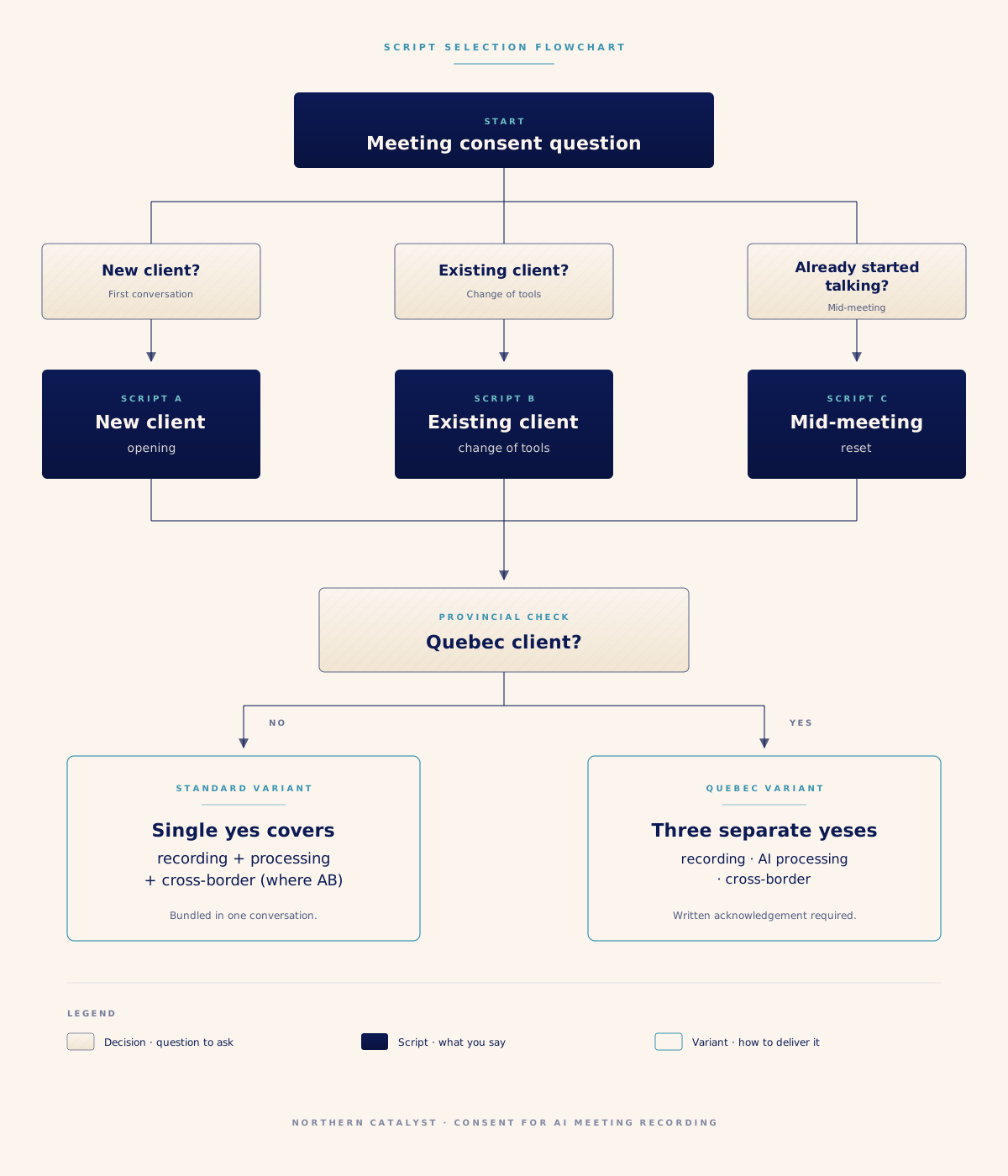
The three-layer stack collapses in practice into a consent conversation that takes under a minute. The three scripts below handle new clients, existing clients starting to use an AI tool mid-relationship, and meetings where the question comes up after the conversation is already underway.
Script A: With a new client
"Before we start, I'd like to tell you how I handle meeting notes. With your permission, I'd record this conversation and use an AI tool to help me write up a summary afterwards. It helps me stay present in the conversation, and the summary captures the detail accurately, which means less follow-up. The recording and the summary stay under my firm's control. The data that travels to the AI provider is already stripped of things that identify you. The service is built to run some of its processing through the United States. You can ask me to stop recording at any time, or to delete what has been recorded. Would you like me to work that way, or would you prefer I take notes manually?"
Offer separate yes or no for recording, for AI processing, and for the cross-border disclosure, rather than bundling them into a single yes.
Script B: With an existing client
"I wanted to mention a small change to how I work. I've started using an AI tool that helps me write summaries of our meetings from a recording. It lets me focus more on our conversation and less on my screen. I kept typed notes before. If you prefer that, that is what we will do. With your permission, the recording and the summary stay under my firm's control. The data that travels to the AI provider is already stripped of things that identify you. You can ask me to stop using the tool at any time."
Present the change in writing as well as verbally, and keep the three consents separate.
Script C: Mid-meeting
"Before we go further, I want to mention something I should have covered at the start. I'd like to record our conversation and use an AI tool to help me write a summary afterwards. The recording and the summary stay under my firm's control. The data that travels to the AI provider is already stripped of things that identify you. Two options: I can do that from this point forward, or I can stop the meeting here, send you a short written note about it, and we can restart when you've had time to consider. Either works for me."
The mid-meeting path is difficult to defend to the CAI. Default to the clean-start option and restart with a written consent request.
What to write down: the CRM audit trail
The record is what an examiner reconstructs. For AI meeting recording, ten categories of CRM fields together build the audit trail that shows consent was obtained, documented before processing began, and honoured through withdrawal and retention.
- Identity and versionConsent form version, Quebec client flag, AI tool version.
- Consent eventSeparate decisions for recording, AI processing, and cross-border disclosure.
- Meeting and processing timestampsIncluding
Consent_Confirmed_Before_Processing. - Data location and routingPrimary storage region, inference routing jurisdictions.
- Withdrawal and partial consentScope of consent, scope of refusal, mid-meeting changes.
- Evidence artefactsSigned PDF, consent form template version, privacy policy version.
- Retention specificationSeven-year CIRO minimum, five-year Quebec incident register.
- Workflow integrationWhen each field is populated across the meeting lifecycle.
- Reconstruction bundleA nine-item evidentiary bundle for regulator review.
- Refusal and withdrawalWhat to document when a client declines or withdraws.
The one field that matters most.
If one field in your CRM carries more weight than any other, it is the one that proves consent preceded processing. Consent_Confirmed_Before_Processing is the boolean-plus-timestamp field that captures this. If it is missing, or its timestamp is later than the processing start, the rest of the audit trail fails regardless of how well everything else is documented.
What US vendors tell you, and what they can't
US AI vendors market to a landscape where wiretap law varies by state, privacy statutes are fragmented, and "no recording" can be a marketing advantage. None of those frames translate cleanly to Canada.
"No recording, no consent question"
Some AI vendors market products that process audio in real time without persisting a recording file. The framing implies that if no recording exists, no consent question arises. That framing does not hold in Canada. Criminal Code section 184 prohibits the interception of a private communication, and "intercept" is defined in section 183 to include listening to a communication, not only recording it.
Brewer v. Otter.ai and US litigation
Brewer v. Otter.ai (US, Northern District of California, filed August 2025) is a class action alleging Otter recorded meetings without all parties' consent. US wiretap statutes do not bind Canadian practice. What the filing signals is a shift in how regulators and courts view AI meeting tools.
Why the regulatory floor is rising.
The OPC concluded its ChatGPT/OpenAI investigation with a consent finding in June 2025. Bill C-27 died on the order paper in January 2025, and a replacement is anticipated. The 2023 OPC Joint Generative AI Principles are already treated by practitioners as the effective standard. CIRO's 2026 Annual Compliance Report named AI for the first time.
What to do with this
Three-layer consent looks heavier on paper than it has to feel in practice. A one-minute conversation at the start of the meeting, a written acknowledgement on file, and a CRM record that shows consent preceded processing are the working parts. Each layer of the stack carries its own regulator, but the advisor's daily handling is one conversation, one document, and one field in the CRM.
Canadian regulators are moving toward a position where AI-assisted documentation is expected to meet a higher bar than traditional notes, not a lower one. The advisor who builds the three-layer discipline now is positioning for the exam before the rule arrives.
The tool is optional. The record is not.
On the Record
Once a month: what is changing across CIRO, PIPEDA, and Quebec Law 25, and what it means for advisors using AI tools. A five-minute read.

Sandra Lyne
Founder, Northern Catalyst
Building tools for Canadian financial advisors
Related Posts
Does CIRO Allow AI Meeting Notes?
CIRO has no formal AI policy, but the 2026 Compliance Report signals exactly what examiners will ask about AI in your practice.
10 min read
What CIRO Requires in Meeting Documentation (2026)
CIRO's five-factor suitability standard and Staff Notice 31-368 show what meeting documentation must demonstrate. The gap is smaller than you think.
20 min read
Meeting Transcription: Your Highest-Risk AI Tool
Meeting transcription combines four compliance risk factors no other AI tool shares. Why it creates unique exposure for Canadian financial advisors.
9 min read