
The meeting record
What RRSP Season Reveals About Your Documentation Systems
RRSP season does not create documentation debt. It reveals the gap between what your systems were designed to handle and what February demands.
TL;DR
The Predictable Surge: When RRSP Season Hits Advisor Documentation
February is the month that defines the Canadian financial advisor's year.
The RRSP contribution deadline drives client engagement to its annual peak, and the scale of that peak is specific. One advisor with twenty-five years of experience described a fifty percent increase in client engagement during RRSP season. Another called it the most transactions out of any two-month period of the year. February 2025 saw $9.0 billion in mutual fund net sales, triple January's $3.0 billion. Nearly half of contributing Canadians make lump-sum RRSP contributions rather than regular monthly deposits, concentrating their advisor interactions into the final weeks before the March deadline. Fewer than one-third of pre-retirement clients have set up automated contributions. The majority still require manual, seasonal attention.
None of this is new information. The RRSP deadline falls on the same date every year. The surge in client meetings follows the same pattern every year. The volume spikes in the same weeks every year. For advisory practices, the predictability is total.
And the documentation requirements have only grown. The Client Focused Reforms that took full effect in 2022 raised the standard for every client interaction, requiring advisors to demonstrate not just what was recommended but why. Each meeting now generates a more comprehensive documentation trail than it did five years ago.
And every one of those meetings needs documentation.
More meetings means more RRSP contribution conversations, more suitability discussions, more know-your-client updates, more compliance documentation. All concentrated into the same sixty-day window. Every year. Each conversation generates its own documentation trail: the know-your-client update confirming the client's current situation, the suitability assessment connecting the contribution to the client's goals and risk tolerance, the record of the recommendation and the reasoning behind it, the follow-up confirming what was discussed and what happens next.
The meetings themselves have always had language around them. Advisors talk about RRSP season the way accountants talk about tax season: a known crunch, a professional rite of passage, something to push through and recover from. But the documentation that follows those meetings has far less language. The notes that don't get written until days after the conversation happened. The compliance records that capture the decision but not the reasoning. The follow-up emails that go out late, with less detail than they would have carried in a slower month.
The RRSP documentation burden is a specific, predictable, annual phenomenon. And it deserves to be examined with the same specificity that advisors bring to the investment decisions they make.
This is about the documentation. Not the meetings. The notes.
The busiest month of the year should test your systems, not your endurance.
Quality Erosion: What Happens to Meeting Notes Under Pressure
When a client meeting happens Monday morning during RRSP season, the notes from that meeting don't always get written Monday afternoon. There are three more meetings that afternoon. And four on Tuesday. And by Wednesday, the notes from Monday morning are still waiting.
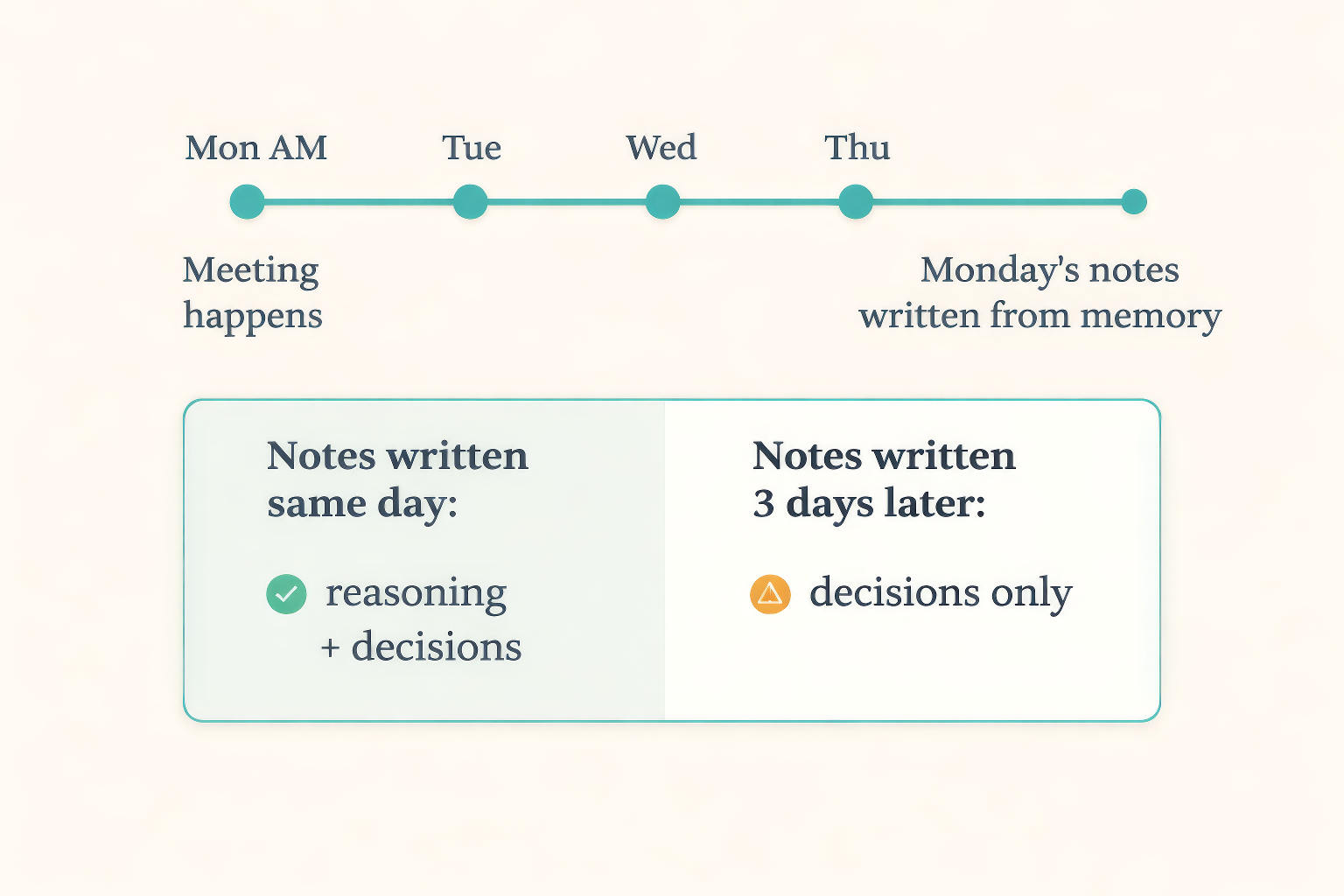
This gap between meeting and documentation does more than shift the schedule. It changes what ends up in the notes, and the cognitive science behind that change is specific.
Research on memory decay has established that approximately fifty percent of newly learned material is lost within one hour without reinforcement, and roughly seventy percent within twenty-four hours. But the more important finding for meeting documentation is that memory doesn't fade uniformly. The relational fabric of a conversation, who raised which concern, how one topic led to another, the specific reasoning that connected a client's circumstances to a recommendation, decays significantly faster than the basic facts of what was decided.
Cognitive scientists describe this as the difference between gist and verbatim memory. The gist of a meeting persists. An advisor remembers recommending a particular fund. But the verbatim reasoning, the specific chain of logic connecting the client's fifteen-year time horizon, their tolerance for volatility, and the comparative fee analysis to that recommendation, fades rapidly. One researcher described it directly: verbatim memory for specific details "becomes rapidly inaccessible." The cognitive cost extends beyond documentation quality. As research on attentional residue shows, unresolved documentation also fragments the attention advisors bring to subsequent meetings.
This has a practical consequence that is easy to overlook. Notes written three days later from memory are not just briefer versions of same-day notes. They are structurally different documents. The decisions remain. The reasoning behind the decisions thins or disappears entirely.
Eyewitness memory research reinforces this finding. Studies have shown that recorded observations made within twenty-four hours of an event are significantly more detailed and accurate than delayed accounts. Medical documentation standards reflect the same reality: Medicare guidance defines reasonable documentation timing as twenty-four to forty-eight hours, stating explicitly that it is unreasonable to expect a provider to recall the specifics of a service two weeks after it was rendered.
A December 2025 regulatory sweep of 105 Canadian firms found exactly this pattern in practice. The review, conducted under CIRO's Client Focused Reforms Phase 2, documented pervasive gaps between decisions recorded and reasoning captured. Firms collected key documents relating to investments but failed to document how that information was reviewed, who conducted the review, and when it was conducted. Risk profiles used checkboxes without explaining how the risk profile was determined. Notes stating only "no update" or "no changes" were deemed insufficient without other evidence that a meaningful interaction had taken place.
The regulatory requirement under the Client Focused Reforms is explicit: documentation must illustrate the reasonable basis for the advisor's determination that an investment action is suitable and puts the client's interest first. That standard requires documented reasoning, not just documented outcomes.
And so the picture comes into focus. Cognitive science predicts that reasoning is the first thing to fade when documentation is delayed. The regulatory sweep confirms that reasoning is exactly what is missing from the files. And those findings came from baseline conditions. Normal operating months. Not from the highest-volume documentation month of the year.
The compounding gap
Cognitive science predicts that reasoning fades first when documentation is delayed. The CIRO regulatory sweep confirms that reasoning is exactly what is missing from client files. These findings came from normal operating months, not from RRSP season.
Documentation Debt: The Compound Weight of Meetings Undocumented
The challenge with RRSP season documentation is not any individual meeting's notes. It is the accumulation.
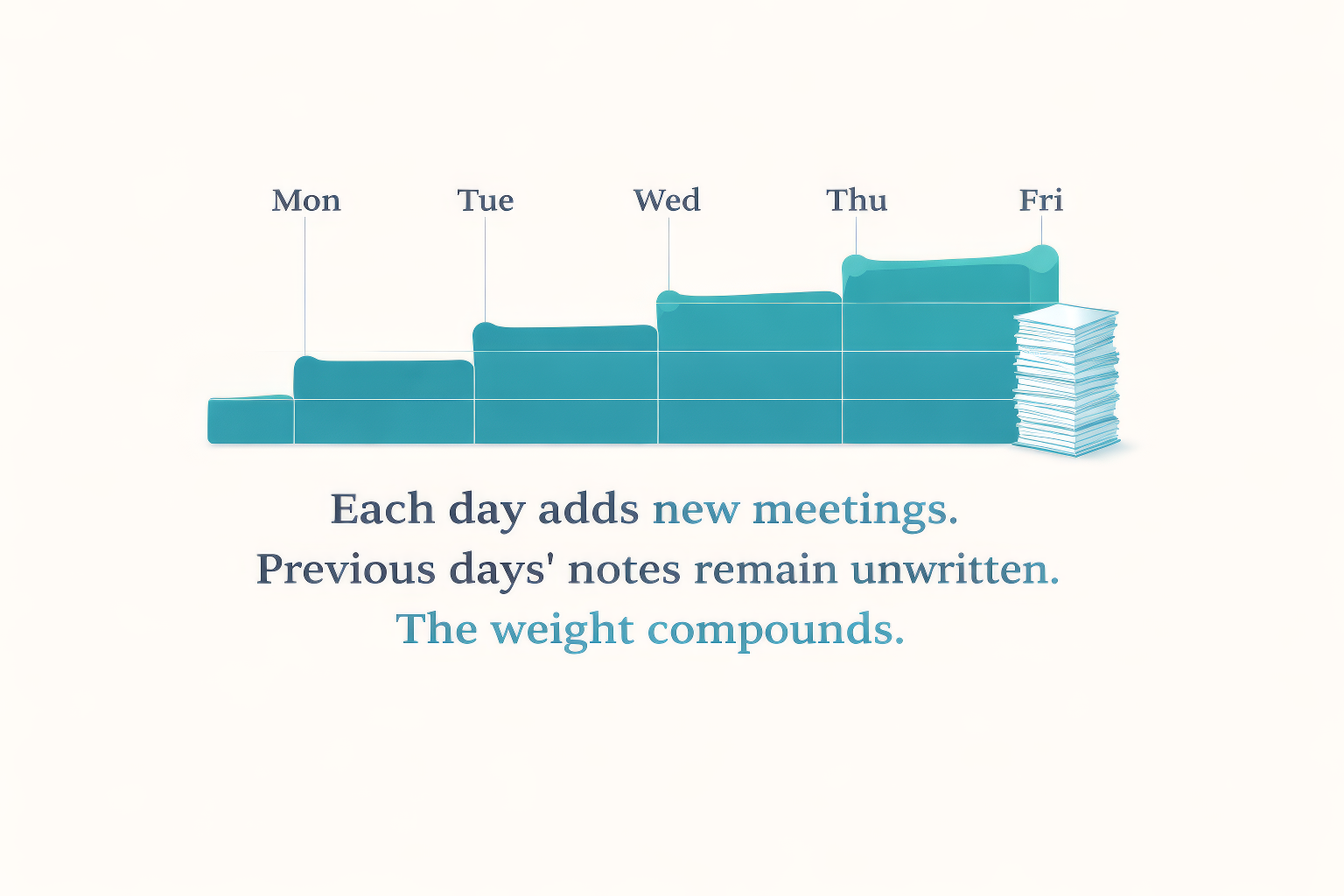
Monday: four client meetings. Tuesday: five. Wednesday: three, plus two follow-up calls. Thursday: four more. By Friday, the documentation from Monday has been waiting all week. And the pile is not just additive. Each day's meetings generate their own follow-up requirements, their own compliance documentation, their own client communications. The undocumented work compounds.
There is a useful analogy from software engineering. In technology development, teams sometimes take shortcuts under deadline pressure, writing code that works but isn't well-structured for long-term maintenance. This is called technical debt. It doesn't break anything immediately. But it accumulates. Each shortcut adds to a growing deficit that eventually requires more time and effort to resolve than it would have taken to do the work properly in the first place.
The same mechanism applies to meeting documentation under seasonal pressure.
Documentation debt is the accumulation of incomplete, delayed, or degraded documentation that compounds during periods of sustained high volume. Like technical debt in software, each individual shortcut is small and often rational in the moment: the notes can wait until tomorrow, the follow-up email can go out with slightly less detail, the compliance file can be updated next week. But the deficit doesn't resolve itself. It carries forward, and the next day's meetings add to it.
Research on professional workload and quality thresholds offers a finding that sharpens this picture. Quality doesn't degrade on a smooth slope. It holds relatively steady until a threshold, and then it drops. A study of 776 auditors found that work quality begins deteriorating at approximately fifty-five to sixty hours per week, with documentation of work performed explicitly named as one of the areas that suffers most when workloads increase. During busy seasons, auditors in the study averaged sixty-five hours per week, five above the threshold where quality began to decline.
Healthcare research confirms the same threshold pattern across professions. Documentation is consistently identified as one of the first elements professionals sacrifice when volume exceeds capacity. Not because they don't value it. Because documentation is the task that can be deferred when everything else requires immediate attention.
The threshold effect
Quality doesn't degrade on a smooth slope. Research on 776 auditors found work quality begins deteriorating at approximately 55–60 hours per week, with documentation of work performed explicitly named as one of the first areas to suffer.
The logic applies directly to RRSP season. The client meetings cannot be deferred. The contribution deadlines cannot be deferred. The compliance conversations cannot be deferred. The documentation can be deferred. And so it is. Day after day, through the busiest two months of the year, the documentation waits while everything that requires immediate attention gets immediate attention.
The Downstream Costs: From Delayed Notes to Compliance Exposure
Documentation debt doesn't stay contained in the documentation.
When meeting notes are delayed, the follow-up communications built on those notes are delayed as well. The email that should confirm a client's RRSP contribution strategy and next steps goes out three days late, with less detail than it would have contained if written the same afternoon. The advisor remembers the decision. The nuance of the conversation that informed it has thinned.
When compliance records capture the recommendation but not the reasoning, the client file is thinner than it should be. Not empty. Not incorrect. Just insufficient. The Client Focused Reforms require documentation that illustrates the reasonable basis for the advisor's determination that an investment action is suitable and puts the client's interest first. That standard requires documented reasoning, not just recorded outcomes. And reasoning, as the cognitive science confirms, is precisely what fades fastest when documentation is delayed.
The regulatory guidance is specific about what constitutes adequate documentation. Know-your-product assessments must show evidence that the advisor understood the product being recommended. Suitability determinations must explain why this particular investment was appropriate for this particular client. These are not administrative formalities. They are the documentary evidence that a professional standard of care was met.
| Documentation gap | What it affects | Downstream cost |
|---|---|---|
| Notes written 3+ days after meeting | Meeting reasoning and context | Compliance records capture decisions but not the reasoning behind them |
| Delayed follow-up emails | Client communication timeliness | Clients experience a gap during their highest-anxiety period |
| KYC updates noting only "no changes" | Regulatory examination readiness | CIRO's December 2025 sweep flagged this exact pattern as insufficient |
| Catch-up work deferred to March | File completeness and accuracy | Notes written weeks later are thinner still, compounding the deficit |
The timing creates a specific kind of exposure. RRSP season is the highest-volume documentation period of the year. February generates more client interactions, more investment decisions, and more documentation requirements than any other month. And the December 2025 regulatory sweep found widespread documentation deficiencies in its review of 105 firms under normal operating conditions. The documentation standard that regulators already find insufficient at baseline is being further tested during the month that demands the most of it.
Client relationships carry downstream costs as well. Delayed follow-up communicates something, even when the advisor's attention and care haven't changed. The gap between the meeting and the written confirmation of what was discussed, what was decided, and what happens next is a gap that clients experience. During RRSP season, when their own concern about the contribution deadline is at its peak, that gap feels larger.
And the costs cascade forward. Incomplete documentation from February creates catch-up work in March. Notes written from memory weeks after the meetings are thinner still. Compliance files updated after the deadline lack the contextual richness of records written the same day. The debt compounds because the very condition that creates it, sustained high volume over sixty days, also prevents the timely repayment.
Every downstream cost traces back to the same origin: documentation deferred because the meeting schedule didn't leave room for it. Not a character failure. A capacity gap.
Tip
Every downstream cost, whether delayed follow-ups, thin compliance records, or incomplete client files, traces back to documentation deferred because the meeting schedule didn't leave room for it. The question is not about working harder. It is about what the system was designed to handle.
The Systems Question: What RRSP Season Actually Reveals
There is a pattern here worth naming clearly.
The RRSP contribution deadline arrives in the same month every year. The client engagement surge follows the same trajectory every year. The meeting volume spikes in the same weeks every year. And the documentation quality degrades in the same ways every year.
Same month. Same deadline. Same volume spike. Same quality erosion.
The pattern is entirely predictable. And a predictable problem that tests endurance rather than systems tells you something about the systems.
The busiest month of the year should test your systems, not your endurance.
If February consistently produces documentation that is later, thinner, and less complete than the documentation produced in any other month, that is not a February problem. It is a capacity problem that February makes visible. RRSP season does not create documentation debt. It reveals the gap between what documentation systems were designed to handle and what the busiest month actually demands.
Advisors already understand this logic in other contexts. A portfolio that fails under predictable market conditions doesn't prompt the response "markets are just hard sometimes." It prompts a structural question: what about the construction made it vulnerable to a foreseeable scenario? The answer is never "push through harder next time." The answer is always about the system.
That same logic applies to documentation.
RRSP season is a stress test for documentation systems. The results come back every February.
And the results are specific. A predictable surge that triggers a specific cascade. Documentation quality erodes because timing gaps degrade the cognitive foundations of accurate notes. The erosion compounds into documentation debt because the volume doesn't pause long enough for the backlog to clear. The debt generates downstream costs because delayed, thin documentation affects client communication, compliance records, and the integrity of the client file. And the entire pattern, from the initial surge through to the compliance implications, repeats identically. Every year.
The pattern has a shape. And now it has a name.
When CIRO, PIPEDA, or Law 25 changes, On the Record explains what it means.
Once a month: what is changing across CIRO, PIPEDA, and Quebec Law 25, and what it means for advisors using AI tools. A five-minute read.
Subscribe, freeIf February tests your endurance every year, and the shape of that test is entirely predictable, what does that tell you about what needs to change?
Frequently asked questions
How much does RRSP season actually increase meeting volume for advisors?
Industry data and advisor accounts consistently describe a 50% or greater increase in client engagement during RRSP season. Nearly half of contributing Canadians make lump-sum RRSP contributions rather than regular monthly deposits, concentrating advisor interactions into the final weeks before the March deadline. February 2025 saw $9.0 billion in mutual fund net sales, triple January's $3.0 billion.
What did CIRO's December 2025 regulatory sweep find about documentation quality?
Joint CSA/CIRO Staff Notice 31-368 reviewed 105 Canadian firms and found widespread gaps between decisions recorded and reasoning captured. Firms collected key documents but failed to document how information was reviewed, who conducted the review, and when. Notes stating only "no update" or "no changes" were deemed insufficient. These findings came from baseline conditions, not from high-volume periods.
How quickly does meeting detail fade from memory?
Research on memory decay shows approximately 50% of newly learned material is lost within one hour and roughly 70% within 24 hours. The key finding for meeting documentation is that relational detail, the reasoning connecting a client's circumstances to a recommendation, fades significantly faster than the basic facts of what was decided. Notes written days later are structurally different documents, not just briefer versions of same-day notes.
Is there a required timeframe for completing meeting documentation?
CIRO does not prescribe a specific documentation timeline. No "same day" or "24-hour" rule exists in Canadian securities regulation. However, case precedent (Re White, 2024 CIRO 67) established that contemporaneous meeting notes carry persuasive evidentiary weight. Medicare guidance from parallel professions defines reasonable documentation timing as 24 to 48 hours.
Key Takeaways
- RRSP season creates a predictable 50% surge in client meetings that repeats identically every year - Memory research shows roughly 50% of meeting detail is lost within one hour and 70% within 24 hours, with reasoning fading fastest - Notes written days later are structurally different documents, not just briefer versions of same-day notes - CIRO's December 2025 review of 105 firms found widespread documentation gaps under normal conditions, before any seasonal pressure - Documentation debt compounds because the volume that creates it also prevents timely repayment
Where this leads
The pattern described in this post, a predictable surge that reveals a capacity gap, has a specific implication. If the documentation system is the constraint, the system is what needs to change.
That starts with understanding what CIRO actually requires. What CIRO Actually Requires for Meeting Documentation translates the five-factor suitability framework into practical, advisor-level guidance. The documentation standard is more specific and less intimidating than most advisors expect. And for advisors evaluating whether AI-assisted documentation might address the capacity gap that February exposes, Getting Started with AI as a Canadian Financial Advisor provides a compliance-first evaluation framework grounded in Canadian regulation.
The busiest month of the year should test your systems, not your endurance. Understanding what that means starts with understanding what the systems are currently being asked to do.
On the Record
Once a month: what is changing across CIRO, PIPEDA, and Quebec Law 25, and what it means for advisors using AI tools. A five-minute read.

Sandra Lyne
Founder, Northern Catalyst
Building tools for Canadian financial advisors
Related Posts
What CIRO Requires in Meeting Documentation (2026)
CIRO's five-factor suitability standard and Staff Notice 31-368 show what meeting documentation must demonstrate. The gap is smaller than you think.
20 min read
Getting Started with AI as a Canadian Financial Advisor: What's Safe, What's Not, and What to Ask Your Compliance Officer
Safe AI starts with four questions, not a tool recommendation. A practical compliance framework for Canadian financial advisors.
19 min read
When Documentation Demands Peak: What Tax Season Reveals About Your Systems
Tax season doesn't break documentation systems. It reveals the ones that were already fragile. That's a systems problem, and systems problems have systems solutions.
8 min read