Why Workflow Optimization Beats Waiting for Agents
Only 11% of organizations have deployed AI agents in production. The more predictable path to AI benefit is optimizing the workflows you already perform.
TL;DR
Every major technology event in the past eighteen months has featured the same demonstration. An AI agent schedules meetings, drafts reports, analyzes data, responds to inquiries, and coordinates follow-up. All autonomously. The capability is real. The demos are impressive.
And the conclusion most professionals draw from watching them is entirely reasonable: learn to work with agents, or wait until the technology matures enough to handle things without deep technical skill. The narrative is consistent across keynotes, vendor showcases, and LinkedIn feeds. Agents writing code. Agents managing projects. Agents analyzing portfolios and generating documentation.
The underlying technology is genuinely advancing, and the demonstrations are not fabricated. These are real systems doing real work. Each demo is more capable than the last. Because the demos are real, the conclusion seems unavoidable: master autonomous AI, or accept that the profession will eventually move past you.
But that conclusion rests on an assumption worth examining. It assumes the sophisticated path is the only path that delivers meaningful value. The person who builds these systems has arrived at a different recommendation.
The Gap Between Demos and Practice
I build agentic AI systems. I design the architectures that let agents reason through complex tasks, manage context across extended processes, and make decisions without constant human oversight. I have loved doing this, simply because of how my mind works. The complexity is genuinely fascinating. And from that direct experience, the practical recommendation I offer most professionals is: don't start there.
The Production Reality
Only 11% of organizations have agentic AI fully operational in production (Deloitte, 2026). Gartner predicts over 40% of agentic AI projects will be cancelled by 2027 due to escalating costs, unclear business value, or inadequate risk controls. The expectation gap is not anecdotal. It is measurable.
This is not false modesty. Building effective agents requires a specific kind of thinking that most professionals reasonably do not want to develop. Agents need the right context: not too much, not too little. They need to understand why a particular outcome matters, not just what the outcome is, so they can reason about how to achieve it.
And when their reasoning diverges from intention, the divergence is often invisible. The thinking happens inside the model. There is a skill and an art to understanding how agents think and what they need. Most professionals do not want to develop that skill. They want the right outcomes, delivered reliably.
The data reinforces what direct experience suggests. 95% of generative AI pilots fail to deliver measurable ROI (MIT NANDA Institute, 2025). Only 23% of organizations have managed to scale AI agents beyond a single function (McKinsey, 2025). 42% of companies abandoned most of their AI initiatives in 2025, up from 17% the year before.
The expectation gap between what demos showcase and what most professionals can practically implement is not a failure of adoption. It is a structural reality. Building autonomous systems and improving existing processes are fundamentally different undertakings. One requires deep technical understanding of how AI reasons. The other requires clear understanding of how work already gets done, and that understanding is far more common.
A More Predictable Path
The more predictable way isn't waiting for agents. It's looking at the workflows you're already doing.
The more predictable way isn't waiting for agents. It's looking at the workflows you're already doing.
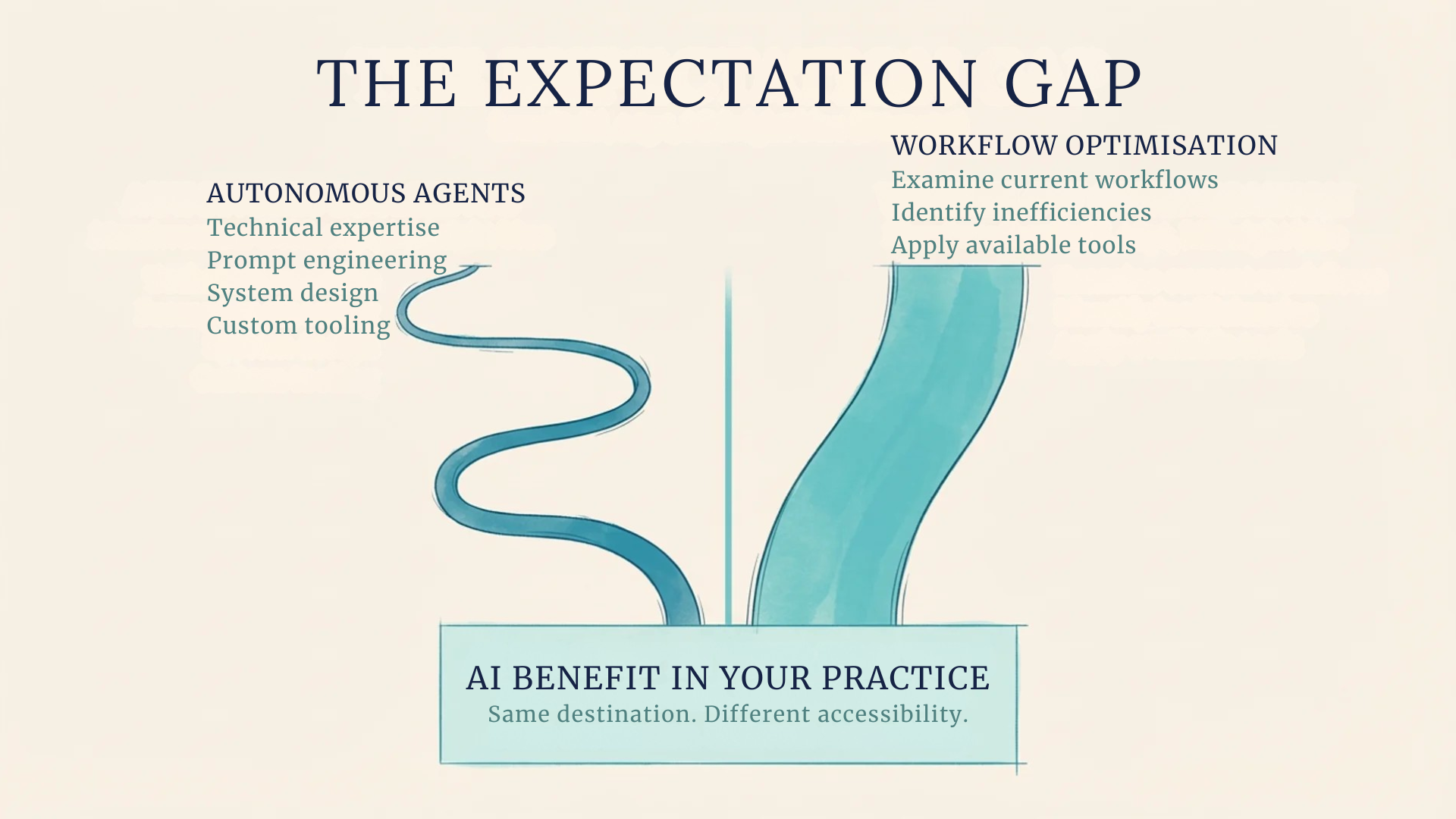
Workflow optimization operates on a fundamentally different principle than autonomous agents. Every step is visible. Every parameter is adjustable. Every output is reviewable before it moves forward. When something needs refinement, the point of adjustment is specific and traceable. There is no hidden reasoning to interpret, no opaque decision-making to reverse-engineer.
This is what I think of as the visible pipeline. The professional who optimizes a workflow can observe what happens at each stage, adjust any individual step, and see the effect immediately. The process remains under professional judgment, enhanced by AI capability rather than replaced by it. As tools improve and as providers address security and compliance properly, each stage in that pipeline becomes a candidate for further improvement.
41% of financial services AI investment now targets optimizing existing workflows rather than building new autonomous systems (NVIDIA, 2026). Even Anthropic, the company that builds the AI models powering many agent systems, recommends starting with the simplest solution: predefined workflow steps before reaching for agent architectures. Workflow optimization is not a lesser approach. It is the approach that delivers more predictable, more controllable outcomes.
Where Advisors Are Already Finding Value
The data on how financial advisors are actually using AI reinforces this. 63% of RIAs now use AI tools, more than double the rate in 2023 (Schwab, January 2026). And the use cases are concentrated not on autonomous agents, but on administrative tasks: notetaking, email drafting, meeting preparation. These are workflow improvements.
This makes sense when you look at how advisors spend their time. Research from Kitces shows advisors spend 36% of their working hours on meeting-adjacent work: preparation, analyses, documentation, follow-up, and servicing. Another 20% goes to overhead and administration. That is more than half of every working week spent on tasks that respond well to workflow-level improvement.
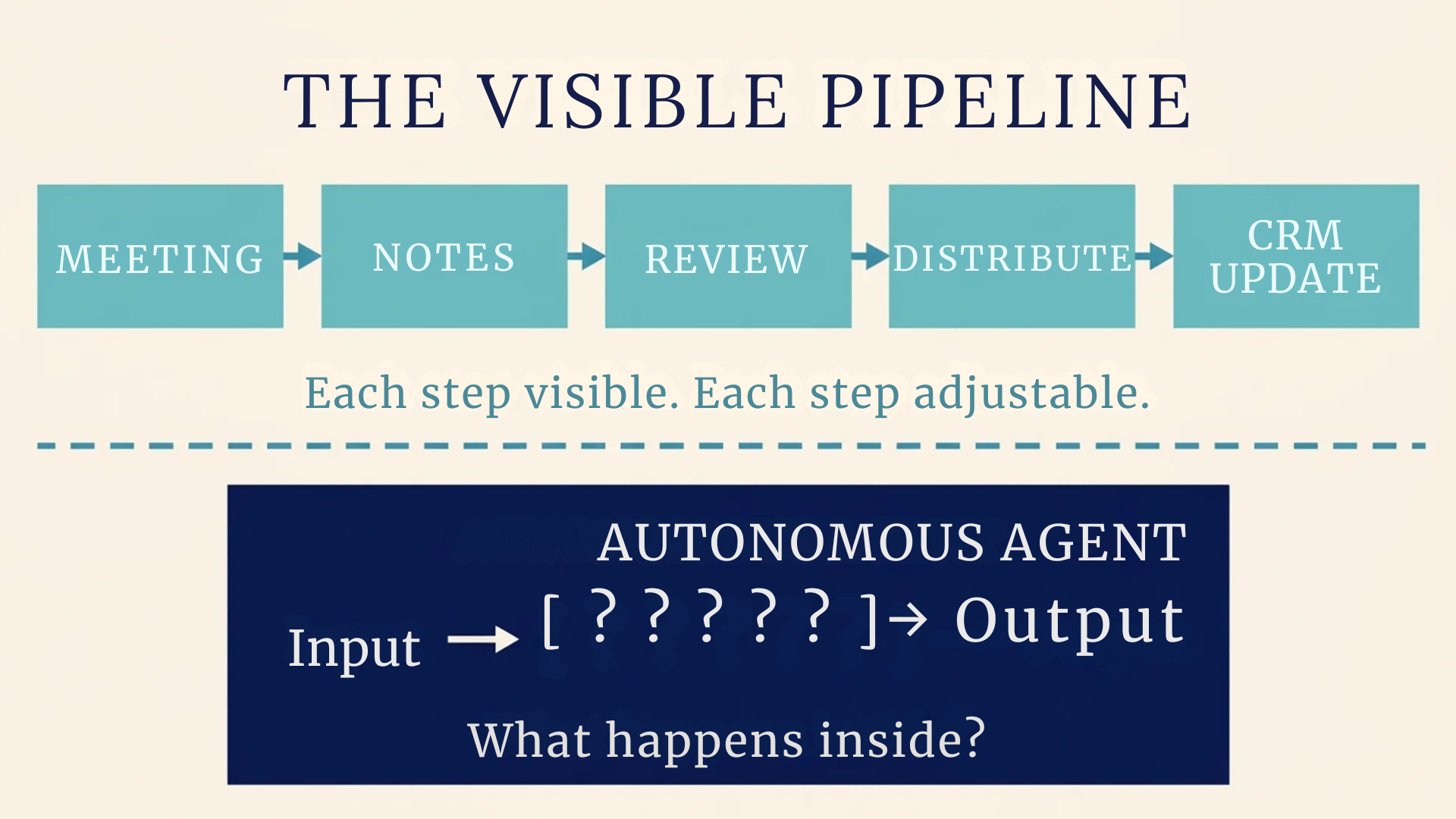
Consider meeting documentation, the workflow that sits at the centre of advisory practice. After a client conversation, an advisor typically needs to produce detailed notes, draft a follow-up email capturing agreed next steps, update the CRM with relevant changes, and ensure the documentation meets compliance requirements. Each step often happens manually, hours or days after the meeting, drawing on memory that has already begun to fade.
Each of those steps is already being performed. The question is not whether to do them, but where available tools could improve accuracy and efficiency. Client follow-up carries similar opportunity: tracking action items across multiple relationships, preparing for the next meeting with relevant context accessible, ensuring nothing agreed upon is missed. These workflows happen weekly. The processes are familiar. The friction points are known.
Advisors who have adopted workflow-level AI tools are reporting measurable results. Purpose-built tools for advisory practice consistently save 10 or more hours per week on documentation and administrative work (Kitces, 2025). 77% of financial services executives report achieving positive ROI from AI within the first year when the focus is on specific, bounded use cases (Google Cloud, 2025). That is time and value recovered without waiting for agent technology to mature.
Why Canadian Advisors Should Pay Particular Attention
For Canadian financial advisors, the case for workflow optimization carries additional regulatory weight. The direction from Canadian regulators is clear, and it structurally favours the workflow approach.
Canadian Regulatory Direction
CSA Staff Notice 11-348 establishes "human-in-the-loop" monitoring and high levels of "explainability" as key principles for AI use in capital markets. CIRO's 2026 Annual Compliance Report confirms that AI use in dealer operations will be examined as part of compliance reviews, and may constitute a "material business change" requiring advance written notification.
Workflow optimization is structurally aligned with these requirements. Every step is visible, auditable, and under professional oversight. Autonomous agents, by design, reduce human oversight. They make decisions inside the model, and the reasoning behind those decisions is not always traceable. In a regulatory environment that is actively moving toward greater explainability and control, the workflow approach is not just more practical. It is the more defensible path. The AI Compliance Guide for Canadian Advisors maps the full regulatory trajectory informing this direction.
When CIRO, PIPEDA, or Law 25 changes, the Dispatch explains what it means.
Once a month: what is changing across CIRO, PIPEDA, and Quebec Law 25, and what it means for advisors using AI tools. A five-minute read.
Subscribe, freeCanadian advisors who adopt AI through workflow optimization are building compliance into their process from the start, rather than retrofitting controls around autonomous systems after the fact. That distinction matters when CIRO reviews how AI is being used in operations.
The Considered Choice
The professionals who benefit most from AI are not the most technically sophisticated. They are those who examined what they already do and found where available tools improve it.
Strategic patience is not passive waiting. It is the professional judgment to improve existing processes rather than pursuing technology that requires expertise most professionals neither have nor want to develop. Each optimized workflow builds competence alongside benefit. Each becomes a foundation for the next improvement. And each provides the kind of documented, auditable process understanding that will make future technology adoption, including agents when they mature, more effective.
The agentic future will continue to develop. When it matures, professionals who understand their own workflows deeply will adopt it more effectively than those who waited without building that foundation. Understanding your own processes is not a temporary measure. It is the permanent advantage.
Examining one workflow, one process where available tools could improve what already happens, is not the cautious approach. It is the considered one.
The more predictable path has always been in the work itself.
Key Takeaways
- The expectation gap between AI demos and professional implementation is real and structural, not a failure of adoption.
- Workflow optimization delivers more predictable, more controllable outcomes than waiting for autonomous AI agents to mature.
- Canadian regulatory direction, including CSA "human-in-the-loop" requirements and CIRO compliance oversight, structurally favours workflow approaches over autonomous agents.
- The advisors benefiting most from AI are not the most technically sophisticated. They are those who examined what they already do and improved it.
- Starting requires no AI expertise: examine one workflow, identify inefficiencies, explore where available tools could help.

Sandy
Founder, Northern Catalyst
Building tools for Canadian financial advisors
Related Posts
Taking Your Time with AI Isn't Falling Behind
A practical starting point for advisors who want honest guidance, not hype. AI doesn't threaten what makes you valuable. It threatens what makes you busy.
8 min read
What CIRO Requires in Meeting Documentation (2026)
CIRO's five-factor suitability standard and Staff Notice 31-368 show what meeting documentation must demonstrate. The gap is smaller than you think.
20 min read
The Most Present Advisors Aren't the Most Talented
Distraction during client meetings is a systems gap, not a personal failing. The most present advisors are not more talented at focusing. They are more prepared.
8 min read