How One Conversation Became Meeting Notes Pro
From one advisor's frustration with ChatGPT to a compliance-first meeting notes tool built from the ground up for Canadian financial advisors.
TL;DR
The Call That Changed Everything
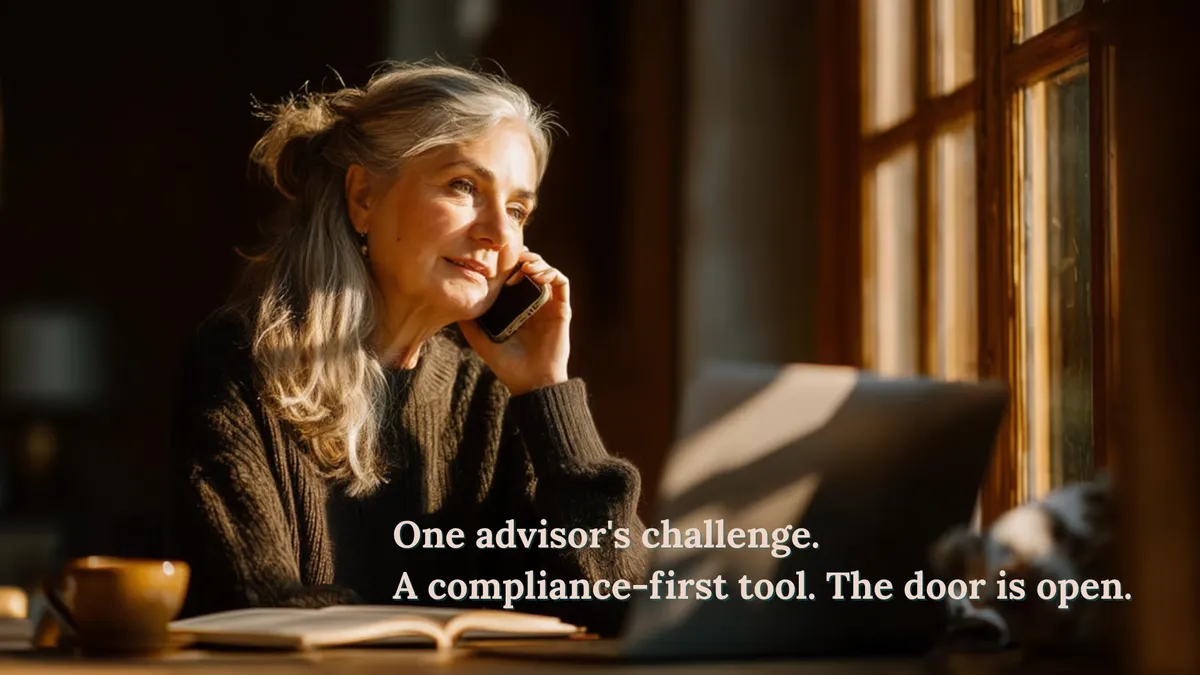
A friend of mine, a financial advisor in Canada, said something on a phone call that I have not been able to put down since.
He had been hearing me talk about AI for months. I was using it in my own work, finding ways to make it genuinely useful, and sharing what I was learning with friends and colleagues. Because of those conversations, he had started trying ChatGPT himself. And on this particular call, he told me what happened.
I can see its potential, but it still feels very much like potential.
He had been scrubbing client names and identifying information from his meeting transcripts, then uploading those sanitized transcripts to ChatGPT to generate meeting summaries. But it wasn't getting things right. The format was wrong. The accuracy was poor. He had to check through the whole transcript and then edit the summary he'd been given, and that took him so long he may as well have typed the notes up from the transcript himself.
This is a person who was already recording his meetings, already working to stay on top of his documentation, already trying to use the tools available to him. And the tool that was supposed to save him time was creating a different kind of work instead.
I like finding solutions for things. I like figuring out how to make something work. And so I took on that challenge.
That was the starting point. One conversation. One advisor's specific frustration with an AI tool that promised much and delivered something that still required hours of editing. Not a market analysis. Not a business plan. Just a friend describing what wasn't working, and me hearing something I wanted to figure out.
Why ChatGPT Fails Canadian Compliance
As I started working on this, I began learning about the world my friend operated in. And it was more complex than I had expected.
Canadian financial advisors work within a compliance landscape that has real weight. CIRO, the Canadian Investment Regulatory Organization, sets documentation standards that require every client conversation to be properly recorded, every recommendation justified in writing. PIPEDA governs how personal information is handled. Quebec has Law 25, which carries fines of up to $25 million CAD or 4% of worldwide turnover. Provincial privacy legislation adds further layers. This is not a casual regulatory environment.
And ChatGPT, the tool advisors were turning to out of necessity, was not built for any of it.
When my friend uploaded his transcripts to ChatGPT, even after scrubbing client names, the data still sat on servers outside of Canada. There was no control over how that information was stored or whether it was used for training. The Teams plan offered more security than the personal plan, but it still didn't meet Canadian compliance requirements, and it hadn't been approved by the investment companies that govern the software advisors use.
PIPEDA isn't GDPR-lite
Quebec's Law 25 carries fines of up to $25 million CAD or 4% of worldwide turnover. Canadian privacy legislation applies to any tool that processes personal information, including AI tools advisors use for meeting transcripts. For a practical framework to evaluate any AI tool against Canadian compliance criteria, four questions matter more than any tool recommendation.
I had been carrying a niggle about this from the start. Because the conversations I was having with advisors revealed something that was not straightforward at all. Some advisors told me they were waiting to see what their investment company would do. Some said their investment company was already addressing AI. But from what I heard from other advisors, what those investment companies were addressing was the back-office work. They were improving internal processes, and doing that well. But they weren't helping with the client-facing documentation that advisors actually needed assistance with.
And so there was this gap. Advisors needed help with meeting notes, client follow-up emails, documentation. The AI tools available to them were generic, non-compliant, and required so much editing they negated the time savings. Their investment companies were focused elsewhere. What were advisors meant to do? Still keep typing notes up manually?
That question kept coming back.
Building What Didn't Exist
I started by building a CustomGPT. It didn't work straightaway. I had to work with it, test it, tweak it, test it again. That was a process. It took a number of rounds before it was producing meeting summaries in the format my friend actually wanted.
And because I was used to getting AI to write things in my own voice and writing style for my own work, I said we can do that too. So I got it to write the client emails in his voice, in his writing style.
I was quite impressed with the final results. And so was he.
He actively told people. He showed them the process he was using, because he was so thrilled with it. Within weeks, colleagues of his, advisors at different firms, had adopted it. He showed them how it worked, and they wanted it for their own practice.
When compliance auditors saw the process and the results, they were impressed themselves. What they specifically liked was the consistency in the meeting notes that were generated. For an auditor, that consistency matters.
But I had been carrying that niggle. The CustomGPT still ran on the ChatGPT platform. The Teams plan had more security than a personal account, but it didn't meet Canadian compliance requirements. And the more I spoke with advisors about it, the more I heard the same things. Pushback about security. Concerns about where client data was going. The gap between what advisors needed and what their investment companies were providing.
I could have left it there. The CustomGPT worked. People were using it. It was saving time.
The compliance problem couldn't be patched. It wasn't a setting I could change.
But the compliance problem couldn't be patched. It wasn't a setting I could change or a feature I could add. The entire architecture of a CustomGPT, running on ChatGPT's platform, with data sitting on servers that were not designed around Canadian privacy requirements, was not going to meet the standard that Canadian advisors needed it to meet.
Rebuilding from the Ground Up
And so I rebuilt it. From scratch.
It felt daunting. Yes. It had been a long time since I had written any code myself, having been a software developer previously. But I knew that my analytical mind and the way I see how things fit together, the way I understand requirements and can turn those into solutions and hold the big picture in mind as well as attend to all the details, I knew I would be able to work towards that.
I did actually think it would be a quicker process than it has turned out to be. Because there have been a number of rewrites of Meeting Notes Pro.
I first looked at using Microsoft and building it on the Microsoft platform, because so many advisors use Microsoft tools. But access to AI processing in Canada through Microsoft takes an enormous investment and can only be done by big companies that can afford to bring Microsoft right onto their servers. That was not going to work.
I looked at using Copilot and building a Copilot agent. But I couldn't configure it to the extent I needed to. It didn't do what I needed it to do.
And so I looked at AWS. They have servers in Canada, including one in Montreal, which means Meeting Notes Pro can serve advisors in Quebec. And the architecture I could build on AWS let me design something from the ground up around Canadian compliance requirements, rather than trying to patch compliance onto a tool that was never built for it.
Why AWS ca-central-1?
AWS maintains servers in Canada, including Montreal (ca-central-1), with ISO 27001 and SOC 2 certifications assessed by the Canadian Centre for Cyber Security. This lets Meeting Notes Pro serve advisors in all provinces, including Quebec under Law 25.
I have definitely thought I don't belong in this space. I'm not a Canadian. I'm not in Canada. I'm in New Zealand. Nothing I've ever done makes me a financial advisor. And so I relied very heavily on my friend and on conversations with other Canadian advisors to understand the challenges in that space. I've had to learn and listen and learn. I was keenly focused on hearing the specific challenges they faced, about the work itself, about compliance, and particularly the Canadian compliance landscape, which is very different from other territories.
But I've taken the time and effort to figure it out. I happen to be a developer who listens and who has figured this out. It's a wide open space. I've seen that there's no one answering this challenge for Canadian advisors. And so I've taken the effort and the time it's taken to develop the knowledge and the expertise I need, to do the research and to build that into the product.
This has not been a case of quickly vibe-coding a product or an app. It hasn't been that at all. I've needed to build in standards and procedures to be sure that the code I'm developing is robust and stable and has been fully tested, both programmatically and through user testing.
How Meeting Notes Pro Actually Works
What emerged from that rebuild is Meeting Notes Pro, and the foundational design decision is this: personally identifiable information is removed on the advisor's own computer before any data is transmitted.
That matters, and it matters specifically. When an advisor records a client meeting, the recording stays on their device. The transcript is generated, and then client names, account numbers, and other identifying information are detected and removed locally, on the advisor's machine. Only the sanitized transcript, with all personal information already stripped out, is sent for AI processing through AWS Bedrock. No client data is stored on external servers. The original recording never leaves the advisor's device.
I rebuilt it this way because the alternative, sending identifiable client information to an external server for processing, was exactly the compliance problem that ChatGPT presented. Removing that information locally, before transmission, was the design decision that made everything else possible.
The AI processing is powered by Claude Opus, and what comes back is a meeting summary in the format that each advisor actually wants. Not a generic template. The summary reflects how each advisor structures their notes, what they consider important, what their compliance team expects. And the client follow-up emails are written in the advisor's own voice and writing style.
Where a big tech company might provide a tool that works, this one is designed specifically for each advisor to work the way they want to work. That personalization is not a feature on a roadmap. It comes from sitting with one advisor's process until it works properly, and then the next, and then the next.
For my friend specifically, the result was this: he literally reclaimed eight hours every week. Hours he's now using as planning time for his business, as development time, as time to work on his business instead of in it. Clients have commented on how thorough his follow-up emails have become. And that CIRO compliance auditor who reviewed the process said, "This is fantastic. This is a great process." What they valued most was the consistency.
The Landscape Advisors Are Navigating
My friend's situation is not unusual. The landscape data tells a story that aligns closely with what I've heard in conversations with advisors.
According to Charles Schwab's 2026 RIA and AI research, 63% of RIA advisors now use AI. That number has more than doubled since 2023. But most firms remain in what Schwab calls the experimentation phase, and only about one in ten have fully integrated AI into their business strategy. The adoption is wide but shallow. Michael Kitces's research characterizes advisors as being in a "collective dabbler" stage.
Advisor360's January 2026 survey found that 93% of financial advisors say retaining control over AI decisions is non-negotiable. For the vast majority of advisors, any AI tool that takes decisions out of their hands is not going to work. Advisors want AI that assists, not AI that replaces their judgement. And 55% of advisors cite compliance as their main barrier to adoption.
The compliance-adoption gap
93% of financial advisors say retaining control over AI decisions is non-negotiable. Yet 55% cite compliance as their main barrier to adoption. The gap is not about willingness. It is about finding tools that meet both needs.
When CIRO, PIPEDA, or Law 25 changes, the Dispatch explains what it means.
Once a month: what is changing across CIRO, PIPEDA, and Quebec Law 25, and what it means for advisors using AI tools. A five-minute read.
Subscribe, freeThe shadow AI situation adds another dimension. IBM's 2025 Cost of a Data Breach report found that 20% of organizations experienced a breach caused by shadow AI, tools employees are using without official approval. That cost an additional $670,000 on average. Harmonic Security's analysis of over 22 million enterprise AI prompts found that employees at more than 90% of organizations are actively using AI tools through personal accounts that IT never approved.
In Canada specifically, Statistics Canada reported that 30.6% of finance and insurance businesses were using AI by mid-2025, nearly tripling from 10.9% just one year earlier. OSFI, the Office of the Superintendent of Financial Institutions, finalized Guideline E-23 in September 2025, effective May 2027, which explicitly includes AI and machine learning models within its governance framework. CIRO launched its InnovateSafe regulatory sandbox in December 2025 with detailed application guidance, creating a pathway for responsible innovation within the regulatory framework.
The regulatory environment is tightening, not loosening. And the gap between what advisors are already doing with AI and the formal governance structures catching up to that reality is where the risk sits. Advisors using personal ChatGPT accounts for client meeting transcripts are operating in that gap. Not because they're reckless. Because the productivity gains are real, and the alternatives haven't been there. For advisors dealing with high-volume periods like RRSP season, documentation pressure compounds the problem further.
The Door Is Open
I think back to that phone call. My friend describing what wasn't working. Me hearing something I wanted to figure out.
What came from that one conversation is a tool that five advisors are now actively using. It has been through nearly a year of real-world testing. It has passed a CIRO compliance audit. It has saved advisors hours every week that they're putting back into their practices. And it was built from the ground up around the specific compliance requirements of Canadian financial services, not retrofitted after the fact.
Meeting Notes Pro is currently in Early Access. That early access serves two purposes. The first is for advisors to try it out and see if it works for their practice. I'm not charging while the beta is running. The second is for me to listen and learn more, to hear and make sure the product works in the way it needs to in order to serve each advisor specifically, rather than being what I've devised and decided will work for them. It becomes refined so that it properly serves each advisor who uses it.
I won't be insisting on feedback. But I will be inviting it. Because meeting notes that properly serve an advisor need to be shaped by that advisor's actual practice, not by assumptions about what advisors want.
If this story resonated with your situation, the door is genuinely open. No countdown. No waitlist. No pressure. Just a tool built because one advisor described a challenge, and a builder who listened.
This started with one conversation. It's growing because it works.
Key Takeaways
- Meeting Notes Pro started from one advisor's frustration with ChatGPT's inability to produce accurate, compliant meeting summaries - Canadian compliance requirements (CIRO, PIPEDA, Law 25) cannot be patched onto tools that were not built for them - Personally identifiable information is removed on the advisor's own device before any data is transmitted - Each advisor's instance is personalized to their format, voice, and compliance requirements - The product has passed a CIRO compliance audit and saved advisors up to eight hours per week
Frequently Asked Questions
How does local PII removal work in Meeting Notes Pro?
When an advisor records a client meeting, the recording stays on their device. The transcript is generated locally, and a PII detection engine identifies client names, account numbers, and other personally identifiable information and removes it on the advisor's computer. Only the sanitized transcript, with all personal information already stripped out, is sent for AI processing. The original recording never leaves the advisor's device.
What happens during a CIRO compliance audit?
One advisor using Meeting Notes Pro has already been through a CIRO compliance audit. The auditor reviewed the process and the meeting notes generated and responded positively. What the auditor specifically valued was the consistency across all meeting documentation. Meeting Notes Pro generates notes in a consistent format for each advisor, which addresses a common audit concern.
How does personalization work?
Each advisor's Meeting Notes Pro instance is configured to their specific requirements. Meeting summaries are produced in the format each advisor actually uses, not a generic template. Client follow-up emails are written in the advisor's own voice and writing style. This personalization develops through the onboarding process and ongoing use, so the tool works the way each advisor works.
What does "Early Access" mean?
Meeting Notes Pro is currently in its Early Access period. Advisors can try the full product at no cost. Early Access is also a listening period, where advisor feedback helps refine the product so it properly serves the way each person actually works. There is no time pressure. The Early Access period continues as long as it needs to.
What is the infrastructure behind Meeting Notes Pro?
Meeting Notes Pro is built on AWS, which maintains ISO 27001 and SOC 2 certifications and has been assessed by the Canadian Centre for Cyber Security. AI processing is powered by Claude Opus via AWS Bedrock with no data retention policies. Data at rest remains in Canada, in AWS's ca-central-1 region.
How can I learn more or get started?
Visit the How It Works page to learn more about Meeting Notes Pro. If the story resonated with your situation, try Meeting Notes Pro. No commitment, no countdown. Just a conversation about whether this might be the right fit for your practice.
Compliance & AI Dispatch
Once a month: what is changing across CIRO, PIPEDA, and Quebec Law 25, and what it means for advisors using AI tools. A five-minute read.

Sandy
Developer & Founder, Northern Catalyst
Building tools for Canadian financial advisors
Related Posts
What CIRO Requires in Meeting Documentation (2026)
CIRO's five-factor suitability standard and Staff Notice 31-368 show what meeting documentation must demonstrate. The gap is smaller than you think.
20 min read
Getting Started with AI as a Canadian Financial Advisor: What's Safe, What's Not, and What to Ask Your Compliance Officer
Safe AI starts with four questions, not a tool recommendation. A practical compliance framework for Canadian financial advisors.
19 min read
Taking Your Time with AI Isn't Falling Behind
A practical starting point for advisors who want honest guidance, not hype. AI doesn't threaten what makes you valuable. It threatens what makes you busy.
8 min read